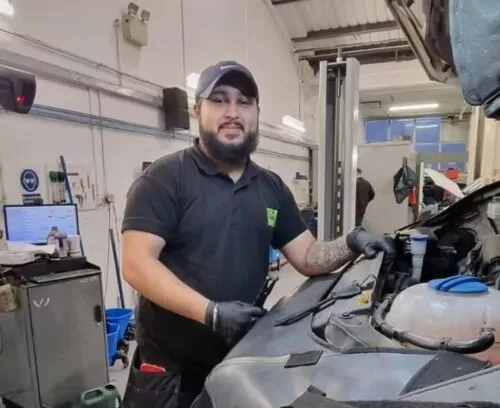
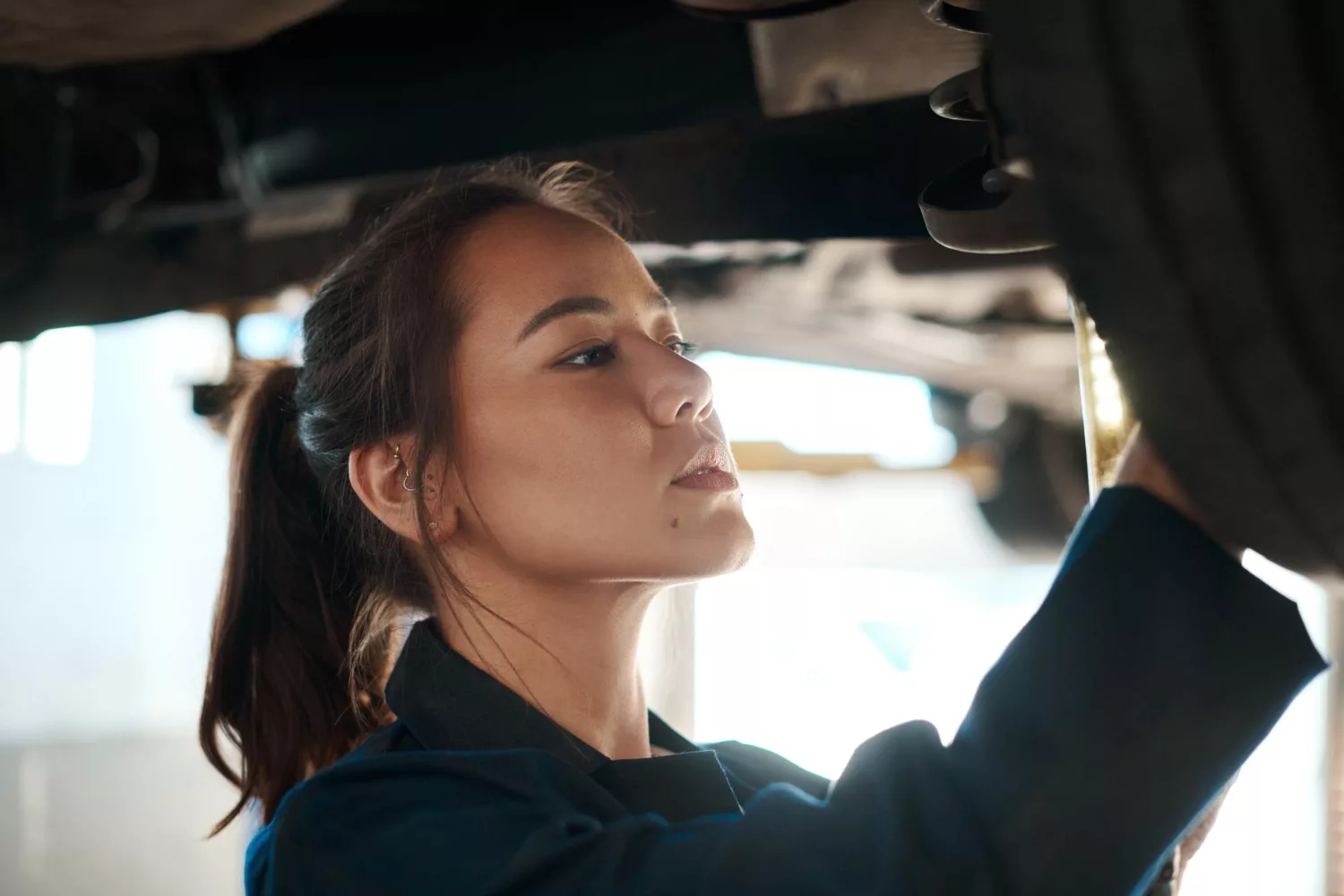
As the Automotive 30% Club’s #ChooseAutomotive campaign spotlights career opportunities during National Careers Week, new evidence suggests a growing number of young women are already stepping forward to build careers in the sector.
Despite ongoing warnings about widening talent shortages across the UK, a new generation of young women is proving that the future of automotive is diverse, driven and ready to work – if given the opportunity.
Industry data shows that women remain a small minority in the UK automotive workforce, especially in technical roles. According to the IMI, women make up only about 11.3% of those working in vehicle maintenance and repair and 18.6% of the wider automotive workforce. Some organisations also note that there are only around 200 female mechanics in the UK compared with roughly 500,000 men highlighting the scale of the imbalance.
At the same time, the sector faces skills shortages and an ageing workforce, increasing the urgency to broaden recruitment and tap into under-represented talent pools.
The Automotive 30% Club’s #ChooseAutomotive campaign aims to put automotive careers firmly on the radar of young people, particularly young women, by showcasing relatable role models and encouraging employers to actively welcome emerging talent.
Encouragingly, colleges are already seeing change. At Stamford College, female participation across motor vehicle programmes has risen significantly in recent years.
Anton Maycock, Motor Vehicle Lecturer at Stamford College, has witnessed the change first-hand:
“When I first started here four years ago, across all of our Level 1 classes we only had two girls, and sadly neither progressed beyond that year. Now, across Level 1 we have around six female students, and in Level 3 six out of nine students are women. That’s a dramatic shift.”
This year’s Level 3 cohort not only features a strong female presence but also represents a reversal of traditional classroom dynamics, with women now outnumbering male students – a stark contrast to the wider automotive workforce.
Anton believes the shift is driven by both personal exposure to the trade and the creation of inclusive learning environments: “Many of the girls have family members who work in the trade, which sparked their interest. But just as importantly, we foster a supportive environment with zero tolerance for sexist behaviour, so they feel confident staying on the course.”
Students say the growing number of women in the classroom now feels normal rather than unusual.
Oliwia, a third-year student at Stamford College who is embarking on an Autotech Academy internship, said her passion for vehicles began at a young age: “I grew up around cars and always found them intriguing. To me, a vehicle is like a massive puzzle, if one piece is wrong, it doesn’t work properly.” However, she also faced barriers when trying to enter the industry before enrolling at college: “I went into garages asking about apprenticeships and was often told they weren’t looking for female apprentices. It’s definitely changing now, but some places are still hesitant.”
Another Level 3 student, Maddie, said seeing a family member succeed in the trade encouraged her to pursue a career in automotive: “My brother completed his Level 2 and Level 3 here too and now he’s a master technician. I used to watch him working on cars outside our house and I was always interested in helping him,” she said. “At first, I was going to study health and social care, but I realised I wanted something more practical. Once I started the motor vehicle course, I knew it was the right choice.”
While colleges are seeing increased female participation, challenges remain in transitioning newly qualified students into employment.
Anton believes closer links between education and employers could help address the issue:
“Even something as simple as one day a week in a garage while studying could make a huge difference. It gives students experience, confidence, and often leads directly to a job.”
As the #ChooseAutomotive campaign highlights the breadth of opportunity across the sector, from workshops and showrooms to EV technology, diagnostics, manufacturing, logistics and leadership, Stamford College’s experience demonstrates that interest among young women is rising.
The next step is clear.
With an ageing workforce approaching retirement and ongoing skills shortages across the industry, the talent pipeline is emerging. Young women are choosing automotive in growing numbers.
Now the automotive industry must choose them.